
Ans: A VPN hardware is a dedicated physical device or specialized server that offers safe remote access to a private network. It works by providing a centralized solution by installing it on a network to configure encryption, decryption, and authentication through network interface cards.
What is a Hardware VPN, How is it Different from Software VPNs, & Top 5 Hardware VPNs?
POST BY
PUBLISHED
April, 16, 2026
A hardware VPN stands for a physical device or dedicated server that serves the purpose of protecting your entire network by encrypting the internet traffic to secure each device connected to the network server.
Similar to a residential VPN, it establishes a safe transmission channel to hide your IP address and provide controlled off-site access with robust security and lightning-fast bandwidth efficiency.
As VPN hardware devices are different from software VPNs and usually require a router or appliance to perform, making it the preferred choice of businesses and privacy-driven power users.
Table of Contents:
- What is a Hardware VPN, How It Works, and Why is It Used?
- What are the Key Differences Between a Hardware VPN and a Software VPN?
- 5 Best Hardware VPN Services for Business Needs and Efficient Data Protection
- How Do Hardware VPNs Deliver Significant Benefits Compared to Software VPNs?
- Wrapping Up
- FAQs
What is a Hardware VPN, How It Works, and Why is It Used?
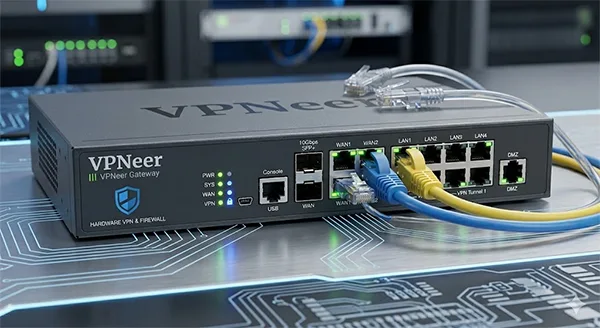
The hardware VPN refers to a dedicated server or physical device that ensures stable and safe remote access to a private network. It works by acting as a specialized intermediary or an exclusive router, firewall, or gateway that connects directly to user devices for achieving optimal data security.
However, they require specialized resources like configured routers and a VPN concentrator to operate, as they create a private and encrypted tunnel to the servers by hiding your IP’s original identity.
As they are more secure and reliable than software VPNs, large enterprises and mid-market companies use them to enable network-wide protection and manage heavy encryption tasks.
It also consists of network switches and load balancers, as VPN hardware maintains security through robust authentication protocols, such as AES-256 or 3DES (Triple Data Encryption Standard).
Also Read: 15 Best Sportsurge Alternatives for Live Sports Streaming in 2026
What are the Key Differences Between a Hardware VPN and a Software VPN?
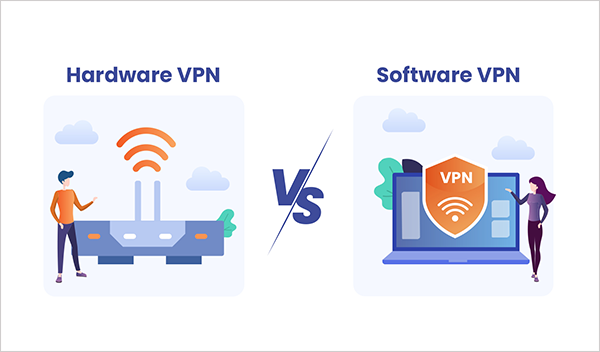
While hardware VPNs ensure maximum security and deliver flawless performance with consistent high speeds, they are different from software services that manage complete encryption on the user device itself.
However, for a quick breakdown of the primary difference between VPN hardware devices and software VPNs, refer to the table below.
| Attributes | Hardware VPN | Software VPN |
| Definition | A hardware VPN is a purpose-built physical device, or dedicated server, such as pre-configured routers or firewalls, that encrypts all the internet traffic from your network and operates independently. | A software VPN refers to an application installed on the user’s device that creates an encrypted VPN tunnel for routing the internet traffic, along with masking the original IP address. |
| Advantages | It ensures an uninterrupted connection with superior performance, along with significant compliance support and device compatibility. | You will gain access to a secure network with easy accessibility, and it is a cost-effective option that boasts an extensive server coverage. |
| Limitations | You will have to face high upfront setup fees, as it also requires a steep learning curve to operate. | Software solutions lack better security controls, and you might have to face lower internet speeds and latency issues on certain networks. |
| Best For | Works best for mid-scale to large organizations that need to configure secure access to their internal networks. | Suits the requirements of individual users who want to bypass geo-restrictions and reduce digital threats while surfing the internet. |
| Subscription Costs | Often carries higher pricing and installation costs compared to software VPNs due to the need for a physical VPN and specific hardware upgrades. | Lower pricing and installation costs as you just have to avail a monthly or yearly subscription. |
| Dedicated Servers and IP Addresses | ✔️ | ❌ |
| Portability and Remote Access | Lacks portability but acts as a reliable remote access VPN with higher levels of data security and privacy. | As software VPNs are installed on your device and don’t require dedicated hardware to operate, they offer significant portability. However, they lack secure remote feasibility with security. |
| Scalability and Advanced Security | ✔️ | ❌ |
5 Best Hardware VPN Services for Business Needs and Efficient Data Protection
From VPNeer to Nordlayer and ExpressVPN AirCove, here are my top 5 recommendations for business VPN hardware that delivers reliable connectivity, global network coverage, and enterprise-grade security functionalities. Explore the complete list below.
1. VPNeer
VPNeer stands as my leading recommendation for a business VPN, thanks to its substantial features of advanced encryption, high-speed global servers, multi-device compatibility, and minimal log policy.
Prominent Features:
- Suits the requirements of startups and small-scale businesses to huge enterprises with easy deployment, best-in-class security features, and 24/7 support.
- Offers a dedicated ad and malware blocker for optimal security, complemented by unlimited device connections and seamless remote access.
- Delivers exceptional performance with lower latency, configuring security, updates, and access controls from a centralized platform.
2. ExpressVPN AirCove

ExpressVPN is among the only options on our list that provides a specialized VPN hardware device for a high level of security and speedy performance by allowing all devices to connect to a single router or network.
Prominent Features:
- The AirCove and AirCove Go offer both portability and vast area coverage for safer operations while mitigating cyber threats, data leaks, and phishing attacks.
- Offers WPA3 level of encryption, along with dual-band WiFi 6, which helps in gaining lag-free performance while executing resource-intensive tasks.
- Whether you own a home business or a mid-level enterprise, ExpressVPN promises to be a suitable choice with budget-friendly subscription packages.
3. NordLayer (NordVPN)
While NordVPN is the industry-leading VPN service, its counterpart NordLayer serves as a dedicated solution for business requirements. With secure remote access, Zero Trust Network Access (ZTNA), and administrative control, Nordlayer upholds the digital security and privacy of your organization.
Prominent Features:
- Its ZTNA feature helps in restricting access to private apps and allowing data transfer based on permissions and user identity.
- Offers advanced privacy and safety features, including threat blocker, kill switch, split tunneling, and usage evaluation for audit preparation.
- Provides support for 2-factor authentication, biometric authentication, single sign-on (SSO), and identity management.
4. ProtonVPN
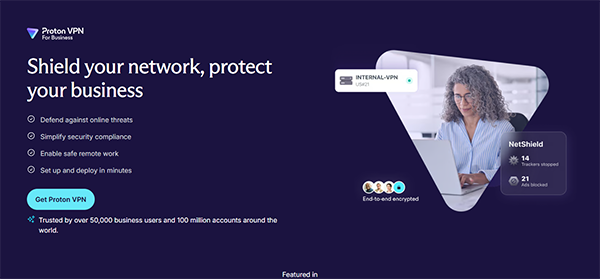
As ProtonVPN has been among the user-favorite services, it also serves as an ideal VPN for business usage. While it provides military-grade encryption and advanced administrative controls, Proton also offers a free plan to suit the needs of beginners.
Prominent Features:
- It is among the best legal VPN services to use, with support for 256-bit and WireGuard encryption protocols.
- While it offers 10 simultaneous connections with its subscription, business users have the flexibility to increase connections as per requirements.
- Along with a centralized dashboard for managing users and licenses, it also supports live tracking of server infrastructure with a dedicated stealth protocol.
5. Surfshark

“Surfshark for Teams” is a prominent business or physical VPN that works best for startups and small organizations. As it offers unlimited simultaneous connections and support for multihop VPN, Surfshark is a budget-friendly VPN that offers advanced features at a competitive price.
Prominent Features:
- Enables seamless remote work and delivers lag-free, consistent performance due to a vast global server presence in over 100 countries.
- Has obfuscated servers for bypassing restrictions, along with split tunneling, kill switch, and clean web (malware blocker) features.
- Possesses over 4500 RAM-only servers for optimal security and identity theft recovery support.
How Do Hardware VPNs Deliver Significant Benefits Compared to Software VPNs?
Support for efficient administrative tasks, higher grade security, lag-free performance, and complete network protection are among the significant benefits of a physical VPN.
However, if you are wondering why you need a VPN, and especially a dedicated hardware VPN for your organization, refer to the pointers below to learn about its prominent advantages.
- Premium Grade Security and Scalability: Hardware VPNs lower the risk of malware installations, data thefts, and cyber attacks, along with adapting to your business growth by managing extreme internet traffic.
- Configured Resources for Lower Redundancy Components: As these solutions require specialized elements, routers, and processing powers to operate, they ensure that your firm can seamlessly perform remote operations with minimal downtime.
- Whole Network Protection for Enhanced Privacy: Rather than individual installation and setup on each device, these services protect all devices that are connected to the network, including those that don’t support VPN apps.
- Better Streaming and Gaming Potential: Whether you are viewing trending movies on Movie4kto alternatives or streaming live matches on premium Stream2Watch alternatives, it ensures consistent performance with lower latency and network delay.
- Unified Management and Compatibility: Centralized administration helps in improving operational efficiency, as you can easily configure, maintain, and monitor network security from a single system.
- Custom Routing Rules and Stable Long-term Connections: Its split tunneling feature lets you control the traffic that goes through the encrypted tunnel. In addition to custom routing, it supports continuous connections without disruptions.
Wrapping Up
Opting for a hardware VPN or a software one depends on your usage and the level of digital security that you need. While a physical VPN is best suited for enterprises and IT professionals due to its dedicated encryption resources, you can use a software VPN for individual usage.
However, if you are confused about which one to pick, I recommend subscribing to VPNeer or ExpressVPN for centralized management and high-speed performance.
FAQs
Q: What is a hardware VPN, and how does it work?
Q: What are 4 different types of VPN services?
Ans: Personal VPNs like NordVPN and VPNeer, along with remote access VPNs, site-to-site VPNs, and mobile VPNs, are the 4 primary types of virtual private network services used worldwide.
Q: Which is the strongest VPN to use?
Ans: VPNeer is highly rated as the strongest VPN by users, owing to its advanced privacy and security features, consisting of military-grade encryption, malware blocker, unlimited device connection support, and high-speed global servers.
Q: What hardware is needed for a VPN?
Ans: For large businesses or multinational corporations, a specialized VPN router is important for secure remote access and data security. However, if you are an individual user, a valid subscription is required, and you can use it after installation.
Related Posts