Revenue First Filter Before Buying Managed Placements
POST BY

PUBLISHED
July, 22, 2026
Guest-post budgets usually arrive before the product can convert a stranger. The site may look finished, but procurement wants indexed URLs. Managed placements often accelerate established sites, but they are the wrong spend while demand is still a hypothesis.
I used a revenue-first filter as the decision gate before BestLinks AI because the service itself tells pre-revenue teams to hold off. This is a buyer-side comparison between spending to create traction versus spending only after revenue proves the page requires more graph weight.
This article outlines what actually counts as revenue proof and the three checks you should know about before you open an intake email.
Key Takeaways
- Investor pressure makes the situation worse. A denser backlink chart shows progress in a board pack even when cash collected does not seem to move
- A handful of real customers, a clear checkout, and a page that can explain itself to a cold visitor are enough to clear the gate. Vanity waitlists and screenshot metrics are not revenue proof for this filter
- Hold the placement budget. Fix offer, onboarding, or pricing first. Teams that skip this pause usually ship a month of links and then ask sales why demos still die on the same confusing screen
- Keep guest posts and Digital PR as separate budget lines with separate success checks. BestLinks AI works best when the guest-post channel starts with “we already earn” rather than “we need proof for investors”
Table of Contents:
Who The Site Says It Is For
The service is for sites already earning. That is not soft branding. It is a refusal to sell “build authority first” to pages that still cannot convert a cold visitor. If paying customers are not yet real, distribution spend becomes theater. You can still mine competitors, write clean English articles, and mark Search Console indexes. You will still lack the commercial proof that makes those URLs compound. Write one sentence on the channel wall: no placement budget until a stranger has paid and the landing page still converts without a founder on the call.
Investor pressure makes the situation worse. A denser backlink chart shows progress in a board pack even when cash collected does not seem to move.
Write the revenue-first filter down before anyone opens the intake email, or else the room will prioritize optimization for charts that impress and pages that still cannot sell.
| Site state | Managed placement role | Better next dollar |
| Pre-revenue or no conversion proof | Wrong primary spend | Offer tests, onboarding, sales calls |
| Early revenue, weak neighborhood | Acceleration tool | Graph-mined English guest posts |
| Strong revenue, messy link ops | Ops replacement | Managed loop with GSC marks |
Read the table left to right. Do not jump to row three because row three feels mature. Earn the row with real payments first.
What Counts As Revenue Proof Here
You do not need enterprise scale. You need repeatable payments from people who were not your friends.
A handful of real customers, a clear checkout, and a page that can explain itself to a cold visitor are enough to clear the gate. Vanity waitlists and screenshot metrics are not revenue proof for this filter.
Who Should Hold Off Before Buying Links
If the answer to “can a stranger pay without a founder on the call?” is no, hold the placement budget. Fix offer, onboarding, or pricing first. Teams that skip this pause usually ship a month of links and then ask sales why demos still die on the same confusing screen.
Premature spend usually fills a content calendar while sales calls expose a conflicting offer. Indexed URLs accumulate. Pipeline stays unchanged. The team concludes guest posts do not work, when the real issue was sequence. Links do not repair an unproven product, and blaming the channel after skipping the revenue gate wastes another quarter.
A Two-Week Gate Before Any Placement Budget
Give the product two weeks of honest conversion work before opening a managed channel. Talk to five unpaid users or five paying ones.
Fix the confusing step noticed by people. If nobody pays after that pass, do not buy neighborhood density yet. If people already pay and the page seems to convert cold visitors, you have already cleared the filter for acceleration speed.
Three Checks Before You Open Intake Email
Can a stranger pay without a founder on the call? Does the landing page convert that stranger at a rate you would fund again? Do you already know which competitors’ neighborhoods matter? Two nos mean hold the placement budget. Three yes answers mean managed mining can accelerate instead of decorate.
What Managed Work Still Costs In Dollars
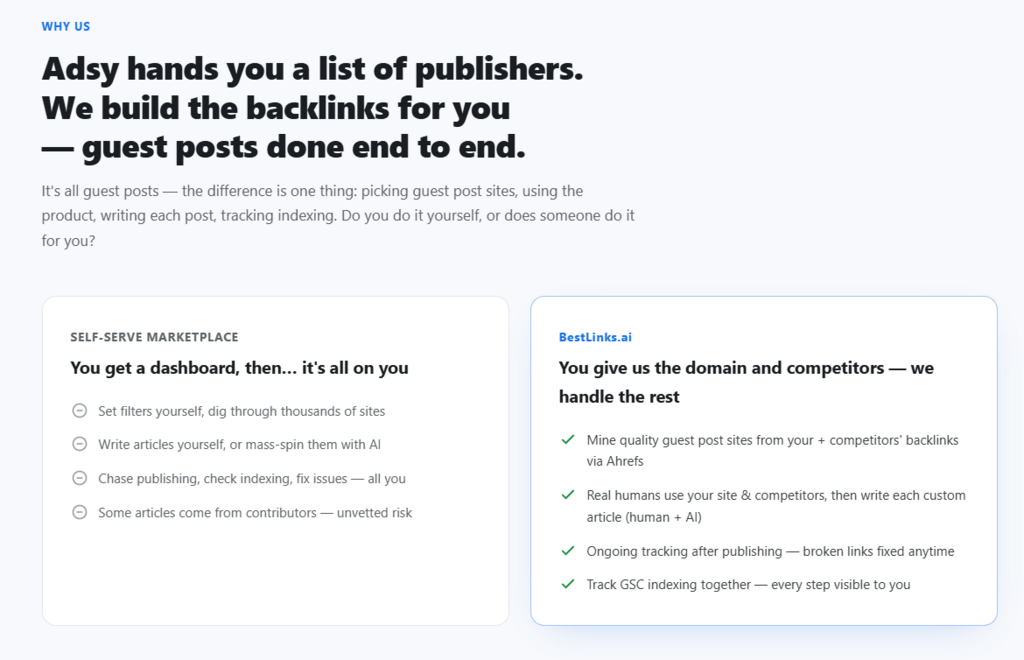
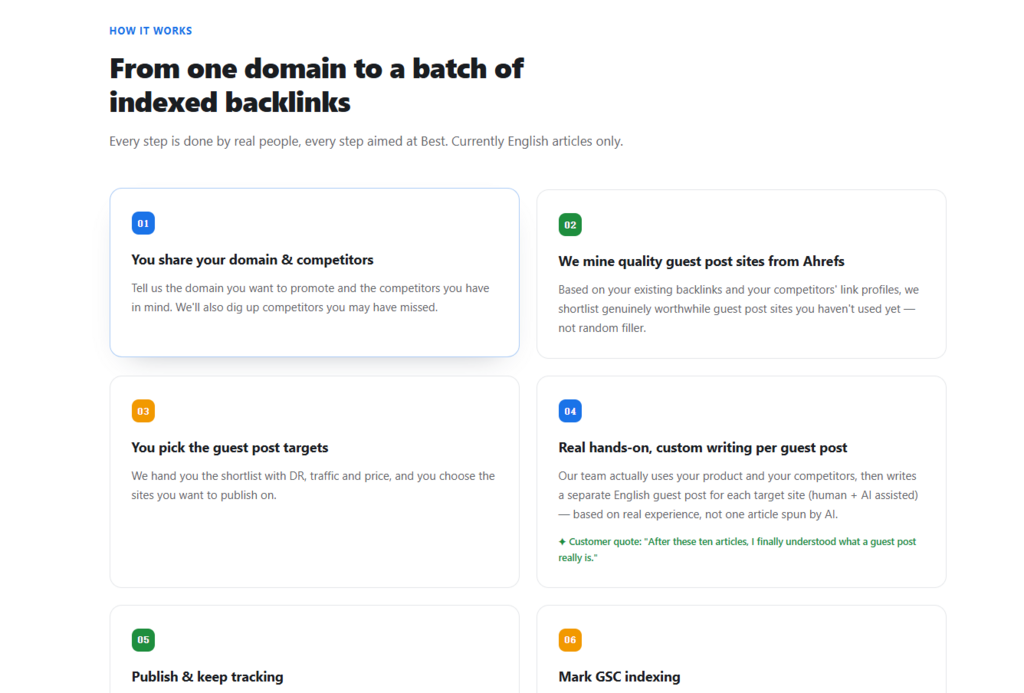
Once revenue clears the gate, managed work has a job: enter competitor link neighborhoods without turning your week into marketplace labor. BestLinks AI mines hosts from your Ahrefs profile and competitor graphs, uses the product, writes with human plus AI support, publishes one by one, and tracks indexing and broken links.
You mark GSC indexing. English-only remains hard. Early access is limited beta. Keep pipeline review beside those index marks so a live URL that does not convert triggers a page fix before the next placement, not a larger catalog order.
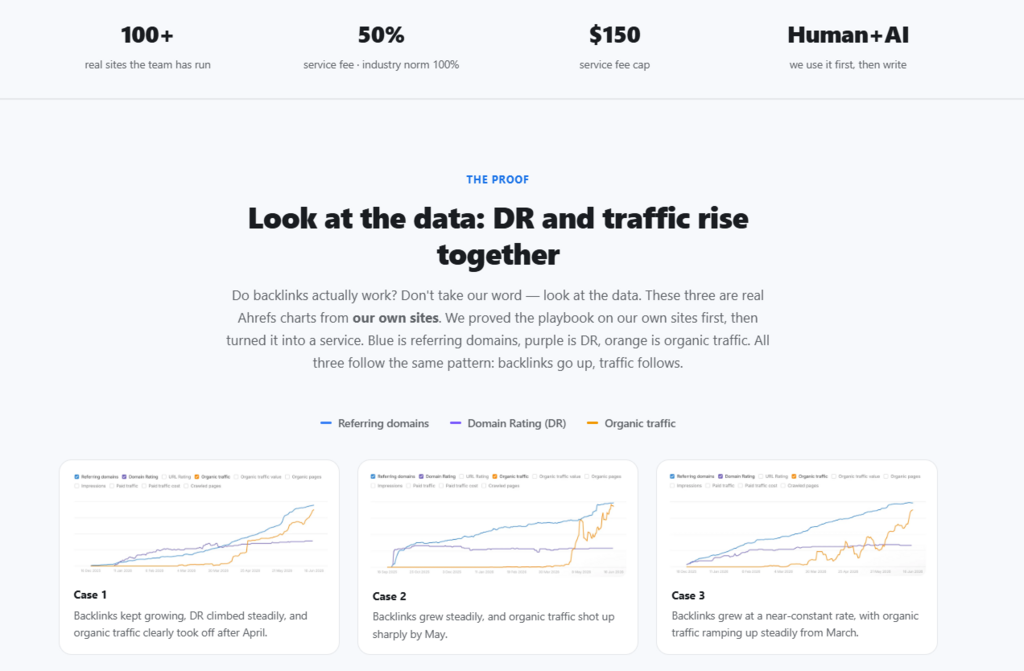
Fee shape is fifty percent of placement with a fifteen-dollar minimum and one-hundred-fifty-dollar cap, and no markup on placement. Proof around the service stays modest and usable: more than one hundred sites run by the team, thirteen beta customers, ten reviews, one refund for non-English demand, two deferred. Ahrefs charts are reference context, not guaranteed traffic lifts.
Intake is still email with domain and competitors, replies within a day, then a dedicated channel. That channel must only be opened after the revenue filter approves the process. Opening it before trains everyone to optimize shortlists for a page that cannot close.
After revenue, a disciplined Guest Post buy is an acceleration line, not a branding line. Keep competitor inputs honest. Keep English fit strict. Keep Search Console marks on the same weekly review as pipeline so distribution never drifts into vanity ops.
Compare Self-Serve Carts Against Managed Acceleration
Self-serve carts optimize for browsing speed. Managed acceleration optimizes for graph fit and publish quality. Pre-revenue teams prefer carts because activity is clearly visible.
Post-revenue teams should focus on mining quality, as the page can already use the traffic. Select the tool for the row you are actually in at the moment, not the row you wish the board pack displayed.
Digital PR Stays A Separate Budget Line
Digital PR through PR Newswire exists if that channel becomes relevant later. Do not fold it into the guest-post revenue filter as a consolation prize. If the product is unproven, a press wire will not invent demand either.
Keep guest posts and Digital PR as separate budget lines with separate success checks. BestLinks AI works best when the guest-post channel starts with “we already earn” rather than “we need proof for investors.”
Where This Still Needs Paying Customers
If paying customers are not yet real, hold the managed budget. English-only and capped fees do not fix weak conversion. Limited beta seats are irrelevant when the offer remains unfinished. Revisit placements after revenue proves the page can utilize new neighborhood traffic.
Hold Or Buy Call After Revenue Proof
Pre-revenue distribution panic is common and expensive. Run offer and conversion work first. When real buyers already pay, managed graph mining becomes rational acceleration instead of costly authority. Put the hold-or-buy call in writing after the two-week conversion gate so the next board meeting cannot reopen a placement cart by default.
BestLinks AI belongs after that gate, not before it. Skip it while the product is still unproven, or if you require non-English placements. For earning sites with thin competitors, revenue-first spending is the filter that keeps guest posts honest, and keeps your next dollar from buying theater.
FAQs
Q1) What is a revenue-first filter?
Ans: A revenue-first filter is a way of deciding whether the business is actually ready to spend money on managed guest post placements.
Q2) How much revenue should a business actually have before performing this?
Ans: There isn’t a fixed number. What matters is having genuine paying customers and a definite way of converting visitors.
Q3) What should be improved before buying managed placements?
Ans: Reviewing the landing page, checkout flow, onboarding experience, pricing, and product message allows the business to understand offers and their benefits before preceding with the next step.
Q4) Is it better to buy links manually?
Ans: No, with manual outreach, you spend most of your time finding prices, negotiating, checking quality, and publishing content yourself, making it very time-consuming. So, it’s better to buy managed placements.
Related Posts