Ans: The Pareto Principle states that 80% of outcomes come from 20% of efforts. For startups: 20% of features typically drive 80% of engagement, and 20% of marketing efforts bring in 80% of customers.
How to Create an Effective Promotion Strategy for Startups
POST BY
PUBLISHED
May, 19, 2026

Whether you’re preparing for a launch or have already shipped the first product, a structured strategy separates founders who gain traction from those who stay stuck with nothing working out in their favour.
The modern consumer market prioritises price and value as the most important factors in choosing where to shop. This clearly indicates that a promotion must focus and communicate value, quickly and without friction.
This comprehensive guide provides you with a complete system containing product-led, organic, paid, and partner-led tactics, combined into a real 90-day plan.
Key Takeaways
- Be clear on your actual constraints, how many hours per week you can commit, and what your team is genuinely proficient at.
- A genuine promotion plan maps every objective to a specific tunnel stage, awareness, activation, revenue, or referral, and combines 1-2 KPIs to each.
- Build a simple channel map mentioning audience size, intent level, and the effort needed to show up there consistently.
- Even founders with strong products tend to stumble on the same issues: chasing every new trend, over-engineering without validation, and underinvesting in positioning.
Table of Contents:
Laying the Groundwork: What Most Startups Skip
Starting a company can be chaotic, even more so when the market doesn’t exactly display a clear path for you to follow. You seem to be fighting for attention with strict budget constraints, a small team, and often zero brand recognition.
That’s the reality. And honestly? That’s exactly why getting your promotion strategy right from the beginning matters so much more than any single campaign you’ll ever run.
Know Your Stage, Resources, and Runway
Your stage shapes everything downstream. Pre-launch? You need a waitlist and an early adopter community. Post-launch?
Focus transitions to activation and retention. Be clear on your actual constraints, how many hours per week you can commit, what your team is genuinely proficient at, and whether you’re bootstrapped or backed.
Make a decision early: founder-led marketing, a part-time hire, or a specialist agency. The correct answer almost entirely depends on where you actually are.
Set Objectives That Mean Something
Vague goals are productivity killers. Simply “getting more users” isn’t a target. Instead, set an objective like 100 beta signups in 60 days or 10 qualified demos every week.
A genuine promotion plan maps every objective to a specific tunnel stage, awareness, activation, revenue, or referral, and combines 1-2 KPIs to each.
That’s the difference between a wishlist and a working plan.
Customer Insight First: Build Around Your ICP
Promoting to the wrong person wastes every dollar and every hour. Getting your Ideal Customer Profile (ICP) right before you pick channels isn’t optional; it’s the whole game.
Narrow Down Your First Audience Segment
Pick one specific industry, role, and use case. Don’t try to serve everyone all at once, as that’s a guaranteed path to serving no one particularly well. Use customer interviews, Reddit threads, Slack communities, and LinkedIn groups to figure out who feels the pain your product aims to solve. The only questions remains is who gets the most value, the fastest.
Figure Out Where They Actually Spend Time
Once you know who they are, learn where they live online. Run SERP analysis on their common search terms. Browse the communities. Check the newsletters and podcasts that they follow. Build a simple channel map mentioning audience size, intent level, and the effort needed to show up there consistently.
Build a Message Bank Before You Write Anything
Before drafting a single ad or social post, sit down and build a message bank. Write one or two pain-first positioning statements in your ICP’s actual language. Layer in your value proposition, supporting proof, and a clear next step. Every asset you create from here, landing pages, emails, social posts, should pull from this bank. Consistency in messaging isn’t just aesthetically nice; it makes your entire approach feel cohesive rather than scattered.
Fun Fact
Rather than spreading thin across all platforms, early success often comes from identifying and mastering a single core marketing channel.
Go Lean: One ICP, Three Channels, Tight Feedback Loops
Early-stage startups that try to be everywhere learn nothing useful. Depth in a few channels beats breadth across many, every time.
Pick Your First Three Channels
Use this simple strategy: one high-intent channel (SEO, target outbound, or marketplace listings), one relationship channel, and one amplification channel (email, social, lightweight PR).
For a B2B SaaS, that might be LinkedIn outreach, Slack community, and a newsletter. For a B2C firm, maybe TikTok, a Reddit community, and a referral program.
Build a Real 90-Day Plan
Structure the 90 days as three sprints. Month one: validate your ICP and message, run interviews, and build foundational assets. Month two: deepen two or three channels and run your first partnership or PR experiment. Month three: scale what’s working, cut what isn’t, and introduce referral and product-led loops. Weekly review checkpoints inside your plan let you compound learning far faster than any static quarterly strategy ever could.
Allocate Time, Budget, and Tools Wisely
For bootstrapped founders, a practical split looks something like: 70% of available time on organic, 20% on partnerships, 10% on small paid experiments.
Research from the DMA shows that automation increases marketing ROI by 32%, meaning even a basic lean stack with email automation, analytics, and a simple CRM punches well above its cost. Use AI to compress work on copy drafts and content repurposing, but keep human review in the loop.
Common Founder Mistakes (Worth Naming Directly)
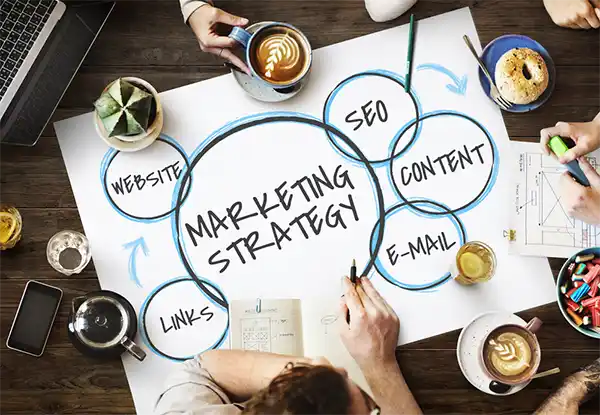
Even founders with strong products tend to stumble on the same issues: chasing every new trend, over-engineering without validation, and underinvesting in positioning.
The fix is straightforward, though: commit to a small number of channels, review regularly, and only add experiments when you have enough data to make the decisions smart rather than reactive.
Where to Go From Here
A strong strategy doesn’t need a gigantic budget or a large team. It requires clarity, consistency, and genuine willingness to test and adapt. Start with one ICP, three channels, and a 90-day sprint.
Construct the system, execute honestly, review regularly, and follow the path. You’ve got everything you need to start right now.
FAQs
Q1) What is the 80/20 rule for startups?
Q2) What is the 7-11-4 rule of marketing?
Ans: It takes seven hours of content, across 11 touchpoints, in four different locations to convert a stranger into a buyer. Consistent multi-channel presence isn’t a nice-to-have; it’s the mechanism behind conversion.
Q3) How long before a startup promotion strategy shows real results?
Ans: Paid and outbound channels can show a signal within days or weeks. SEO and community-building typically take three to six months to compound meaningfully.
Q4) What are the common founder mistakes?
Ans: Chasing every new trend, over-engineering without prior validation, and underinvesting in positioning are a few mistakes that founders usually make.
Related Posts