Scalability, Availability, Reliability, and Performance.
Building Scalable Software Architecture: Strategies for CTOs
POST BY
PUBLISHED
March, 10, 2026

“Good architecture allows for future change without the need for complete rewrites.”
– Kevlin Henney (Software Development Author and Consultant)
That’s why integrating scalability in your business applications from the get-go is important.
When your business is small, you can manage. But the problem starts once it eventually begins to grow. More customers, more data.
An unscalable software would become a bottleneck in this situation and would lead to the breakdown of the entire system.
The responsibility of keeping the system architecture scalable falls upon Chief Technology Officers. Making prompt decisions during the application design phase itself would beget a resilient system that doesn’t get bogged down by an immense load.
In this article, I’ll explain scalable software architecture and its core principles. The following sections will make you sufficiently aware of these concepts, so you don’t make any mistakes regarding choosing the best architecture for your upcoming system overhaul.
KEY TAKEAWAYS
- System scalability allows free business growth.
- CTOs are responsible for looking after a business system design being scalable and choosing the right architecture.
- While chasing growth and scalability, don’t compromise on system reliability or security.
Table of Contents:
Understanding The Core Principles Of Scalable Software Architecture
The main aim of scalability is to develop apps that can change, mostly in the expanding sense, while keeping the entire framework intact and functioning.
But before you start building the next-gen platform your company needs, you need to get the basics right. These core ideas will shape how your software responds as your business takes off.
Designing systems that adapt to growth
A truly scalable system doesn’t need a complete overhaul every time your workload spikes. Thanks to modular design, you can swap in new features or scale up specific services without rebuilding the app from the ground up. The end result is fewer disruptions and the freedom to adapt as your organization grows.
Balancing performance, reliability, and flexibility
Striking the right balance between scalability, reliability, and performance ensures hiccup-free performance.
For example, if you have an e-commerce platform, the software powering it must be capable of handling peak traffic while ensuring consistent uptime and fast response times. This flexibility is what you need to launch new features without risking stability or speed.
Aligning architecture with business objectives
The only way to make fool-proof software architecture decisions is to align them with your company’s central organizational goals. So if increasing customers is your business goal, make sure the software is capable of handling a large volume of orders as your company grows.
Turning to custom software development services can help you build an architecture that supports core organizational objectives. With software built around your specific workflows, you get a system that can scale efficiently without any limitations like off-the-shelf software often does.
Choosing the Right Architectural Patterns
A CTO can’t go wrong in selecting the best architecture for the company’s software system. At least, he/she shouldn’t.
Each architecture comes with its own USPs. How flexible, complex, and fast the final system might turn out to be would also vary. Deciding whether the trade-offs and quirks are worth it needs serious evaluation.
Monolithic vs microservices architectures
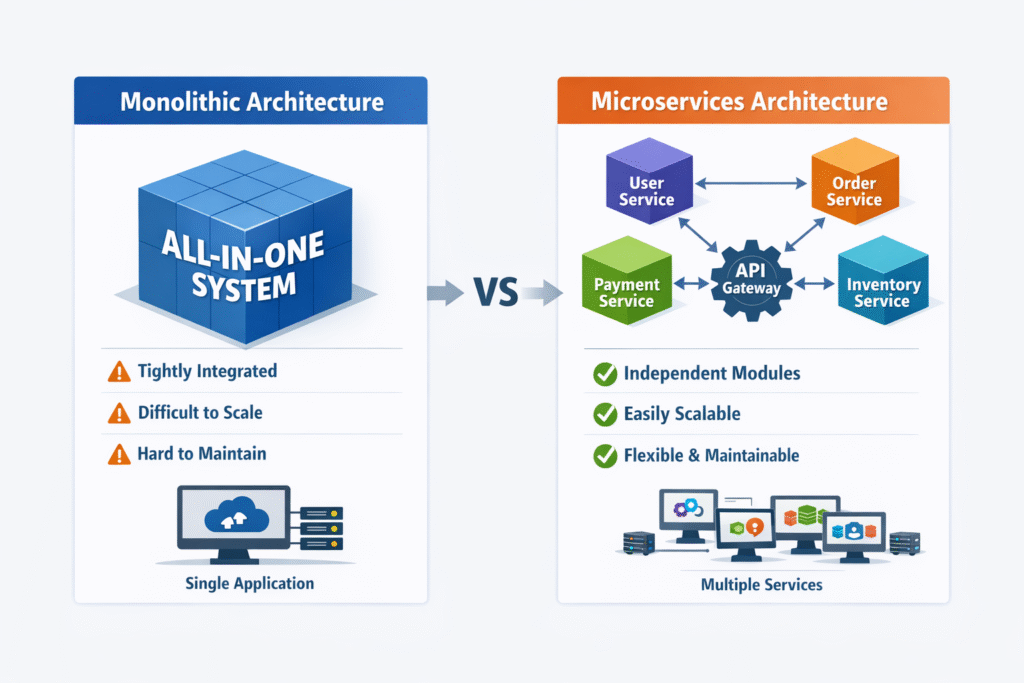
The traditional option, monolithic architecture, uses a single codebase for all modules in a particular application. Though it simplifies initial development, it is undoubtedly harder to scale and is bound to become rigid with time.
Microservices architecture is way more flexible. It splits the individual modules of an application into smaller, independent services that communicate with each other via APIs. This gives you the option to deploy, maintain, and scale each service individually, which means you get a more change-adaptive platform.
However, complexity is in the very nature of this architecture – especially for businesses involved in service management and communication.
The following infographic depicts the difference between monolithic and microservice architecture:
Event-driven architecture for high scalability
If your business requires handling huge amounts of data going from one place to another, event-driven architecture must be your first choice.
Herein, parts of the system react to triggers/events, simultaneously handling many tasks on its own.
When it comes to scalability, event-driven architecture is a great choice as it allows the system to process multiple events at the same time without breaking down or suffering from bottlenecks. If you’re engaged in businesses that require real-time data processing, such as finance, e-commerce, or streaming services, this architecture is what the doctor ordered.
API-first design for future integrations
Building a robust, well-documented interface before implementing core functionality is the focus of API-first app design. The major benefit of this approach is the enabling of free communication between other systems and third-party tools.
It’s easily the most flexible choice and should feature high on a CTO’s radar. Modules, workflows, and integrations make the platform flexible enough that it evolves with minimal disruptions.
For example, a customizable ERP can help you connect multiple systems, establish cross-departmental communication, and brace for change as operational needs expand.
Building Infrastructure That Supports Growth
You cannot go on building floor after floor on a wiggly foundation. The same is true for software. If the underlying system infrastructure isn’t scalable, you can’t go on expanding capabilities or add newer features to it.
If you want your systems to handle sudden surges and growing workloads, you’ve got to build an infrastructure that’s ready for anything.
Cloud-native infrastructure and containerization
Having your applications built on a cloud-native environment makes it easy to scale them dynamically based on demand. Slap modern technologies such as containerization on top, and you end up with an application that is easier to package and deploy consistently across all environments. Moreover, containers enable more optimized resource allocation.
Auto-scaling and load-balancing strategies
As the name suggests, auto-scaling automatically allocates resources based on factors like traffic levels. Suppose high-demand comes, then the auto-scaling system deploys additional resources to keep the system running at an optimal performance.
On the other hand, load balancing evenly spreads out app traffic across multiple servers, preventing a system crash. Combined, both these strategies guarantee consistent performance even during spikes in user activity.
Leveraging managed services for performance
Cloud platforms typically provide additional services that focus on management tasks such as database scaling, monitoring, and maintenance, thereby reducing operational complexity.
Ensuring Security & Reliability At Scale
Expanding your system to handle increased load doesn’t mean that you compromise on its reliability or security.
You’re dealing with sensitive data, and it needs to stay protected at all costs.
Implementing secure access control
Incorporating strong access and identity management strategies is essential. Scalable systems that offer role-based access, multi-factor authentication, and secure API gateways are successful in preventing unauthorized access to critical data.
Fault tolerance and disaster recovery planning
Fault tolerance is like a fail-safe. It allows your software to continue functioning even when a few of its components fail. An automated failover mechanism is what you need to keep things up and running as unexpected disruptions turn up as unwelcome guests.
As for disaster recovery management, make sure you have data backup strategies and recovery procedures in place to prevent loss of critical data during system failure.
Continuous monitoring and observability
Elements such as monitoring tools and observability platforms keep tabs on your system’s performance in real-time. They offer valuable insights, such as app metrics, logs, traces, etc. The IT team can use this information to quickly resolve issues and optimize system performance.
Conclusion
Businesses today are standing upon their software. A scalable system allows business growth, while a static one doesn’t. And the system scalability is again a function of its infrastructure and security.
Choosing the right patterns, building for reliability, and staying on top of security might be vital decisions the CTO has to make, but they have a top-down effect on your entire company’s operations. They are what keep your systems stable, scalable, and aligned with broader organizational goals, no matter what the future has in store.
What are the 4 pillars of software architecture?
Why is system scalability important?
Its absence can become a bottleneck in business growth.
Who is responsible for deciding business software architecture?
Chief Technology Officers.
Related Posts