Ans: Yes, Residential VPNs are a bit on the higher side in terms of cost because of the need to maintain a large network, whereas regular VPNs are more affordable.
What is a Residential VPN? Functions, Benefits, and Use Cases
POST BY
PUBLISHED
March, 17, 2026
Do you know that you can be easily blocked from accessing your favourite geo-restricted sites & streaming platforms anytime, even if you use a VPN?
Yes, the science behind it is pretty straightforward. Traditional VPNs provide data center IPs that are often linked with spam, bots, or mass data scraping.
So, what is the solution? A Residential VPN. Sounds interesting, doesn’t it? Let’s dive deep and learn more about VPN with residential ip.
Table of Contents:
- What is a Residential VPN and How it Works?
- What are the Pros and Cons of Residential VPN?
- Real-World Use Cases of Residential VPN
- What’s The Key Difference Between A Traditional Vpn And A Residential VPN
- 5 Best Residential VPNs: The Industry Pioneers
- How to Choose the Right Residential VPN?
- Conclusion
- FAQs (Frequently Asked Questions)
What is a Residential VPN and How it Works?
As mentioned above, a Residential VPN is a secure anonymity service that provides a natural online footprint that significantly reduces the probability of being blocked or blacklisted by sites that monitor suspicious traffic.
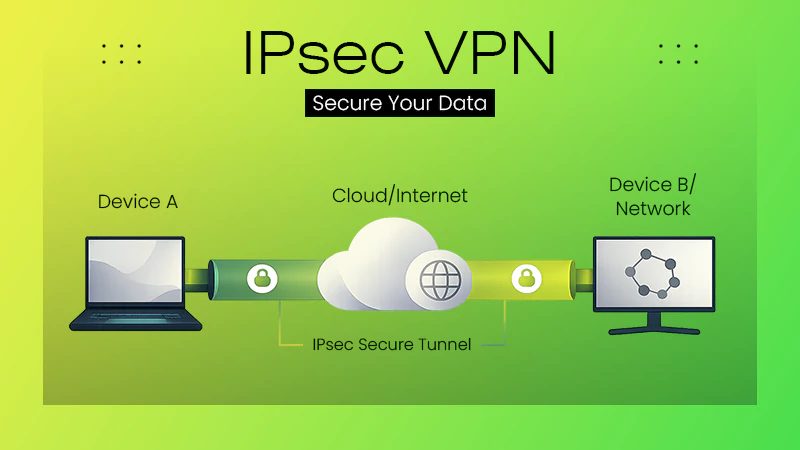
- It routes your internet traffic through a VPN tunnel using real residential IP addresses given by the Internet Service Providers to households because residential IPs are associated with physical location and real-world identity, and are therefore considered more legitimate than datacenter IPs.
Let’s understand with an example, suppose you connect to a US or Canada-based residencial vpn to access a restricted website. In this scenario, the respective VPN will showcase your internet activity originating from a normal US/Canada home.
- It is used for several personal and professional online activities where authentication is non-negotiable, such as collecting data, validating digital ads, or analyzing localized content.
In simple terms, it will enhance your privacy, reduce CAPTCHA challenges, and provide better access to geo-restricted content.
What are the Pros and Cons of Residential VPN?
Here are the pros and cons of a residential VPN that will provide a bigger picture of its offerings:
| Pros | Cons |
| Top-tier online security that provides a natural online presence. | Higher cost than traditional VPNs. |
| It uses real residential IP addresses assigned by Internet Service Providers. | Unstable performance; depends on node availability, location, and network conditions. |
| It uses advanced encryption protocols, leak protection, and reliable server uptime that enhances privacy. | Occasional slowdowns during peak times. |
| Minimizes the risk of detection or being blocked by websites. | Privacy concerns arise as certain providers rely on peer-to-peer networks. |
| Prevents hackers or meddlers from tracking online activity or any interception. | |
| Versatile; can be used for online activities such as ad verification and market research. |
Real-World Use Cases of Residential VPN
A Residential VPN’s natural identity masquerading ability makes it a go-to tool across different facets, especially in environments where there’s no substitute for authenticity and trust.
Users use it for personal and professional purposes, from data collection and ad verification to automating purchases on popular websites. Residential VPN versatility speaks volumes.
So, let’s explore the real-world use cases of this VPN.
- Market Research: Many companies and digital agencies use both paid and free residential vpns to conduct meticulous research.
It helps them view websites and ads from the perspective of real users, providing a clear picture of the displayed content and other important elements, such as pricing, promotions, and geo-targeted schemes, to determine whether they are consistent.
- Ad Verification: Organizations also leverage residential network to validate ads, including verifying ad delivery to the targeted audience and detecting ad fraud. It can also be used to track competitors’ activity because it uses real residential IPs that appear to be coming from an actual household.
- Data Collection/Web Scraping: Another productive use of residencial vpn is web scraping, or data accumulation. An excellent tool that enables scrapers to collect data without getting blocked or poking anti-bot systems conveniently.
It is also proven effective in SEO research, eCommerce analytics, and travel fare tracking.
- Automating Purchases: A non-conventional area where Residential VPNs’ popularity is soaring is automated purchases. Users are using it to buy sneakers and other limited-commodity items on high-demand websites. Thanks to its ability to rotate real, reliable IP addresses.
Now that you know how you can also use this robust and secure tool for different pursuits, let’s see how you choose the right vpn that prioritizes residential IPs.
What’s The Key Difference Between A Traditional Vpn And A Residential VPN?
The key differences that draw a parallel between a traditional VPN (Virtual Private Network) and a Residential VPN are as follows:
| Traditional VPN | Residential VPN |
| Sends your internet traffic through special servers, arranged in large data centers. | Route your online activity through a network of real home internet connections. |
| It uses commercial data center IPs that are used by many people and organizations | It uses real residential IP addresses that are associated with real customer devices such as home routers and smartphones. |
| Cloud hosting companies own traditional VPNs. | The Internet Service Providers assign it to actual homes. |
| Easily recognizable by websites that it belongs to the servers or VPN providers. | It masks your online identity as a real, typical residential user, making it hard to identify. |
| It is more likely to be restricted or blacklisted by websites and other geo-restricted platforms. | It substantially reduces the likelihood that the connection will be blocked, restricted, or subjected to additional security checks. |
So these are the major key differences between a regular and a Residential VPN. As you can deduce, the residential network appears to be a safer choice than your regular VPN.
But how to find the best Residential VPNs with promising offerings, positive reviews, and testimonials?
Don’t worry, we’ve got you covered in the next section that features the top 5 best resi vpn in the industry that are used by both for personal and professional purposes.
Top 5 Best Residential VPNs: The Industry Pioneers
Here are the leading Residential VPNs that promise a safe & protect browsing experience and mean it:
VPNeer- Best Overall True Residential VPN
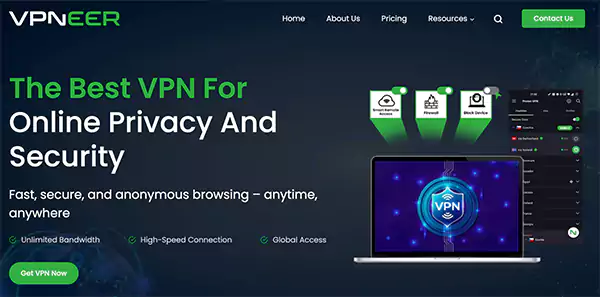
VPNeer is the industry standard VPN that is widely regarded as the best overall Residential VPN choice. It prioritizes Residential IPs and securely routes your data from real home ISP connections instead of easily identifiable datacenter IPs.
Key Features:
- Decentralised node-based model with over thousands of residential IPs from real households globally.
- Advanced encryption that safeguards from unauthorized interceptions.
- Parental control to filter inappropriate content, set usage limits and provide a safe browsing background.
- Strict zero-log policy
- Lighting-fast downloads; reduces unwanted lags and throttling.
Mysterium VPN
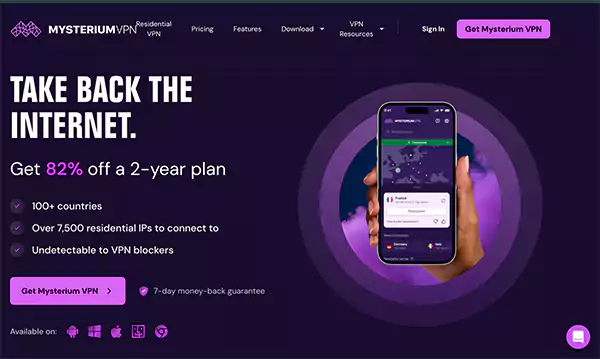
Mysterium VPN is another blistering Residential VPN that is known for its formidable decentralized node-based model with over 7500+ residential IPs. It makes it super-challenging for platforms and unauthorized surveillance to detect as a VPN in contrast to standard datacenter-based services.
Key Features:
- A giant decentralized node-based mode with a network of thousands of residential IPs.
- Safeguards 15 simultaneous devices at the same time.
- Powered by military-grade encryption that provides elite online security and empowers sensitive online activities, such as online banking, messaging, and social media.
- Provides robust features such as a VPN kill switch, perfect forward secrecy, WireGuard protocol, and no logs whatsoever.
- Scattered across over 135+ countries.
Nord VPN
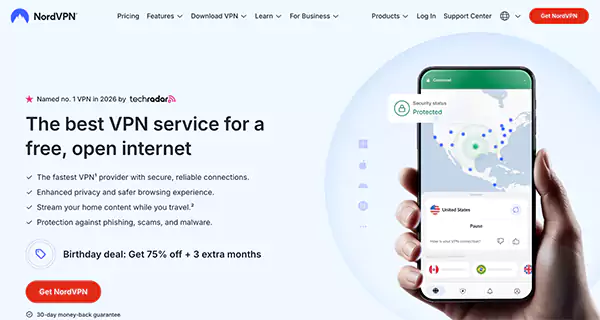
Nord VPN is a popular anonymity service provider that also prioritizes Residential IPs to deliver an enhanced privacy and protected browsing experience.
The beating heart of the respective VPN is an integrated anti-malware tool called Threat Protection Pro that scans websites you access and files you download for threats in the background silently.
Key Features:
- Over 9000+ VPN servers covering 188+ locations; sheer global access.
- High-grade encryption protocols, such as Threat Protection Pro, that prevent phishing, scams, and malware.
- Users can connect up to 10 devices at the same time or configure it on a Wi-Fi router for complete home protection.
- Faster downloads and one of the best VPN for streaming with strong connections to Double VPN servers.
- Nord VPN also offers cloud storage.
Surfshark
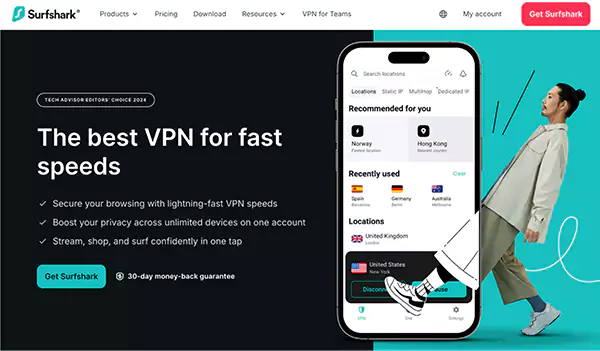
Surfshark is also positioned in the list of the best Residential VPNs due to its usage of trusted security protocols such as WireGuard, IKEv2, and OpenVPN, and a next-gen privacy network that links all VPN servers into a global ecosystem.
Key Features:
- Hassle-free, user-friendly VPN application that effortlessly changes virtual location via a private tunnel.
- Strong network of 4500+ serves in 100+ countries.
- Unlimited simultaneous connections that can protect multiple devices at the same time.
- 100Gbps Servers for fast and stable connections.
- Fast speeds for smooth streaming, browsing, and gaming.
- No tracking, storing, or selling online browsing data policy.
StarVPN
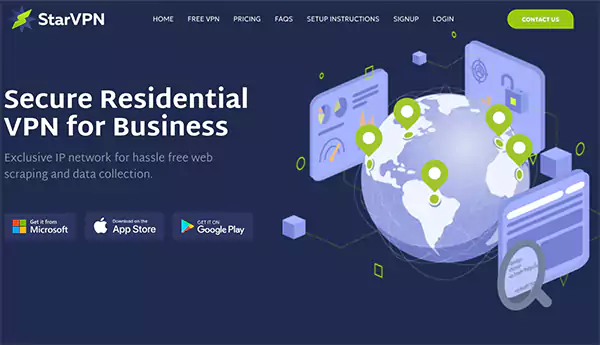
For web scraping and data collection, StartVPN emerges as a top contender that offers a secure Residential VPN for businesses. It also boasts over 3M+ real residential IP’s and 1000+ access servers globally.
Key Features:
- One of the largest VPN proxy operators in the VPN market.
- Promises to deliver premium dedicated residential IP’s with the fastest and most reliable network connections.
- Integrated with Smart DNS technology that provides safe and secure access to online streaming services.
- Offers API and IP for precise SEO monitoring data.
- AEZ-256 advanced encryption and AmneziaWG.
- Comply with a strictly enforced no-log policy.
How to Choose the Right Residential VPN?
To maximize and enjoy the benefits of a Residential VPN without compromising your security, choosing a verified, trusted, and fastest VPN service provider holds the utmost significance.
It is imperative to conduct a deep research of the service providers’ track record in protecting user privacy before committing to long-term use.
Selecting a VPN with Residential IPs is a time-consuming process that requires careful assessment of numerous factors. But trust us, your efforts will reward you with enhanced privacy, unparalleled authenticity, and sheer reliability.
So, let’s explore the factors that account for the ideal Residential VPN.
- Transparency: A Resi VPN provider must clearly state their sources of residential IP addresses, including their usage of peer-to-peer connections or voluntary participation.
This information will prevent you from unintended involvement in networks that leverage other people’s devices without their permission.
- Privacy: A strong track record in safeguarding user privacy is another indispensable factor that can’t be ignored when choosing a Residencial VPN. The provider must comply with strict no-log policies.
It implies that they can’t monitor or store your browsing history. So, make sure you evaluate the privacy policy meticulously before making a serious commitment.
- Strong Security Protocols: To maintain the integrity of your network and protect your sensitive online activity, robust security protocols are mandatory.
Therefore, advanced encryption protocols, leak protection tools, and a trustworthy server uptime should be a must-have feature in your Residential VPN to make sure your VPN can’t be tracked.
- Customer Support & Testimonials: A positive report card from customer reviews & testimonials and independent audits is a bold testament to a reputable, reliable VPN service provider.
It highlights the moral principles and ethical practices of the VPN provider. Also, make sure not to be deceived by too-good-to-be-true offerings such as free unlimited access, as it will only lead to data theft, unwanted ads, and malicious malware.
- IP Pool Diversity: Last but not least, a healthy and diverse residential IP pool is a solid indicator of uncompromised service. It ensures minimum risk of detection and elevates performance for private use cases such as conducting research, automation, or professional assessment.
So these are the crucial factors you should keep in mind when choosing a Residential VPN, a process of weighing important factors and understanding the potential trade-offs.
Conclusion
Residential VPN is a phenomenal instrument for users who seek more than just basic online security.
It is a combination of privacy, security, and authenticity that uses real residential IPs to ensure that your online activity is not intercepted or overdropped by hackers or snoopers.
So, if you’re someone who conducts market research & collects data, verifies digital campaigns, uses web scraping, or just likes to automate purchasing, resi vpn is designed for you!
FAQs (Frequently Asked Questions)
Q: Are Residential VPNs costlier than regular VPNs?
Q: What kind of IP addresses do Residential VPNs use?
Ans: Residential VPNs use real residential IP addresses assigned by Internet Service Providers to genuine households, which enhances privacy and reduces the risk of being blocked or restricted by platforms.
Q: Which VPN provides faster speed and stable connections?
Ans: Traditional VPNs tend to provide faster speeds and more stable connections because of robust, centralized servers located in data centres, which are rented and managed by VPN service providers.
Q: What is the biggest challenge of installing a Residential VPN?
Ans: Complex and expensive infrastructure is the biggest challenge that comes with Residential VPNs. It requires a large, distributed network of user devices that is hard to manage and maintain.
Q: Is Residential VPN safe to use?
Ans: Yes, Residential VPNs are completely safe to use if you choose a verified, reputable provider that complies with privacy regulations and offers transparent policies.
Although Residential VPNs route your online data through a real residential IP address, unlike regular VPNs, they provide untraceable, secure access to geo-restricted content.
Sources:
Best residential VPN providers in 2026: Cybernews
Related Posts