Using a proxy involves various security risks. One of the primary risks includes a lack of encryption. Unless configured with encryption, a proxy operates with an unsecured connection.
Classifying the Main Types of Proxy Server
POST BY
PUBLISHED
April, 1, 2026
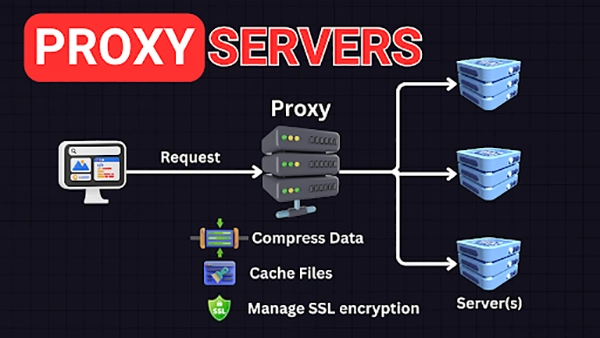
In the world of tech, proxy servers have a significant role to play.
Especially when you work with several factors such as routers, firewalls, and network infrastructure, all at the same time.
These gateways are an important component that determines the loading of content and controls latency as well.
This is why understanding the classification of different proxy servers is significant.
Read further to know more!
Functional Categorization of Different Types of Proxies
These intermediaries can be classified according to their location in the network stack and their connection with the client.
Clients send their requests to external servers through a forward proxy, which sits in front of them. This is common in business environments, where administrators must block employee web traffic at the edge.
In contrast, a reverse proxy resides behind the firewall to protect the origin server. It accepts incoming requests and allocates them to a backend group of servers.
This technique enhances reliability because no single server is overloaded with high activity spikes.
This is frequently used in high-availability settings where uptime is a factor.
Assessment of IP Sources and Infrastructure
What is the source of the IP address of your gateway?
This question defines the technical difference between a data centre and a residential proxy.
The former relies on IP addresses that are given to home users by Internet Service Providers (ISPs).
These speeches are presented as real user devices, which is useful in cases when you have to climb smoothly within the limits of the platform without causing automated bot detection.
But a datacenter proxy originates from secondary corporations and high-speed server farms.
These have much greater throughput and cost per unit than residential options.
They lack the natural appearance of residential IPs, but they excel at high-volume tasks requiring massive bandwidth.
And they tend to have the lowest latency with data-intensive applications.
Table: Types of Proxy Server
You can further assess the different types of proxy servers from the table :
| Typical Latency | Success Rate | Cost Basis | |
| Residential | 0.8s – 1.5s | 95%–98% | Per GB |
| Datacenter | 0.05s – 0.2s | 80%–90% | Per IP/Port |
| Mobile | 1.2s–3.0s | 99% | High premium |
Analyzing Performance Metrics of Types of Proxy Servers
High-performance clusters often rely on rotating proxy servers to maintain high success rates over prolonged periods.
These systems automatically rotate a pool of IPs with each request or after a designated period.
With a rotation system, you avoid a single IP being a contention point when data is being collected intensively.
Protocol Layers and the OSI Model
Most web traffic moves through HTTP and HTTPS proxies that operate at the application layer.
These gateways understand the traffic, and this enables them to temporarily store web pages and block certain URL patterns depending on the content.
If you need to handle more than just web requests, you might look at a SOCKS5 proxy for your setup.
The SOCKS5 protocol is lower level than HTTP. It manages SMTP, FTP, and even VoIP data.
Since it does not decode the traffic, it provides quicker processing of non-web protocols.
Implementation Styles for Enterprise Types of Proxy Server
A transparent proxy identifies itself to the destination server and passes the original IP address in the header.
These are used to filter content in large organizations without any configuration on the user device side.
However, in case you want to conceal the client IP, you would select a more restrictive type.
An elite proxy provides the best level of concealment by eliminating any evidence of the client and the node itself in the request.
It does not send the HTTP_X_FORWARDED_FOR or HTTP_VIA headers. This setup causes the request to appear as though it was made by a regular user.
Due to this fact, it is the one that is preferred when it comes to sensitive data collection.
Strategic Selection for Scaling Operations
Engineers are usually torn between speed and high success rates.
A simple datacenter setup may be sufficient in case your project requires simple subnetting or internal testing.
However, in bigger operations, you require specialized providers.
Services such as proxyseller provide dedicated ports to different protocols, which are high-quality resources.
Most professionals would want to have dedicated IPs so that their reputation and performance are not influenced by other users.
Have you thought of how a dedicated subnet could enhance your connection stability at peak hours?
Infrastructure Planning: Real-World Cost Analysis
These technologies need to be budgeted based on the usage patterns.
Datacenter solutions tend to be the cheapest, ranging between $1.00 and $2.50 per dedicated IP per month.
Because residential pools rely on real user hardware, they are pricier.
The residential traffic pricing typically begins at approximately $10.00 to $15.00 per GB for small volumes.
At the terabyte scale, the price can be reduced to $3.00 or $5.00 per GB. ISP-hosted nodes are also provided by many providers and are a combination of datacenter speeds and the reputation of residential IPs.
- Shared IPs: $0.50–$1.00 per IP (cheapest, but higher risk of noise).
- Dedicated Datacenter: $1.50–$3.00 per IP (stable and fast).
- Residential (Rotating): $10/GB (high success for web data).
- Mobile (4G/5G): $40–$80 per month (highest reputation).
Such analysis is very helpful for making wise choices.
Integrating Types of Proxy Server Into Local Networks
Deployment typically requires the setup of a gateway on the periphery of your network.
To avoid packet loss, you should also confirm that the gateway is set up to perform NAT correctly.
To distribute traffic among multiple nodes, load balancers are employed in most contemporary setups.
Will you deploy a hardware-based gateway or a cloud-based solution?
Hardware gives greater control of the physical connection, whereas cloud solutions are instantly scalable.
Both are equally justified depending on whether you care about low-level hardware access or speed of operation.
Final Technical Considerations for Engineers
Choosing between types of proxy servers requires considering your current protocol and upcoming request volume.
The implementation process for HTTP-based systems requires less effort, but SOCKS5 offers users complete network stack customization.
The industry now shows a tendency to adopt automated API-driven rotation systems.
You must assess different system configurations during periods of high usage if you want to build an infrastructure that works effectively.
The IP pool health status needs continuous evaluation to maintain stable performance.
Your network achieves optimal performance because of your correct IP server selection, which enables it to manage high-speed data demands.
The Bottom Line
Deciding the right proxy is an integral step to ensure a better protocol and proper utilization of the volume.
This requires a good analysis of the real-time cost and implementation analysis to judge which proxy suits you the best.
In a nutshell, if you want to achieve the pinnacles of tech, make sure you choose the appropriate proxy!
FAQs
What are the risks of using a proxy?
What is the validity of a proxy?
A proxy is expected to be valid only for the period for which it is intended. Such conditions are often expected in the case of stockholders, lawyers and administrators.
What is the timeout of a proxy session?
Session Timeout is the maximum time (in seconds) during which a single proxy connection can run without interruption.
How long do proxies last?
Proxies lifespan is often dedicated by the provider’s policies, while some policies offer fixed access, others rely on usage-based limits.
Related Posts