Ans: IPsec generally uses port 500
What is IPsec, and How does IPsec VPN Secure Your Data?
POST BY
PUBLISHED
March, 13, 2026
IPsec, a type of VPN tunneling protocol that is used by VPN service providers to create a secure connection between devices by encrypting and authenticating.
Read on as this article focuses on what is the ipsec vpn
IPsec, its benefits, how it works, and much more, with the answer to an important question: Is IPsec VPN worth it?
So, let’s discover IPsec!
Table of Contents:
What is IPsec, and Why IPsec VPN is Necessary?
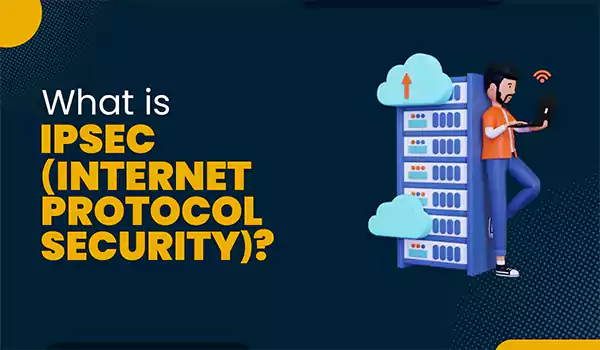
IPsec is a suite of protocols that is used to set up private, protected connections (VPNs) between devices by encrypting and authenticating IP packets at the network level.
In layman’s terms, it keeps your data secure over public networks.
Analogy: Think of IPsec as an envelope that keeps your messages (data) enclosed, impeding them from interceptions (hacking & snooping) while it travels through networks.
- IPsec is also highly scalable & flexible in nature, which makes it a staple for large enterprise environments and suitable for gaming VPNs.
- It uses two modes for deployment: Tunnel Mode and Transport Mode, which you will explore more in the upcoming sections.
However, there are networking protocol suites such as TCP/IP that only emphasize connection and delivery of the data, which implies that your information can be intercepted by unauthorized forces.
How does IPsec VPN Work?
An IPsec VPN refers to a VPN that utilizes the IPSec protocol suite to create a protected connection between devices, apps, or networks over the public network to ensure that the traveling data is secure and encrypted.
It is necessary because:
- It leverages a robust technique called “VPN Tunnelling” to encrypt the traffic between the device and the VPN server.
- The IPsec VPN is mainly used for high-speed, powerful cyphers, rapid connection establishment, and adaptability with operating systems, routers, and other network devices.
IPsec VPN first encapsulates your data into an IPsec packet, then encrypts it using a cipher. Next, the encrypted data is forwarded over the internet to the VPN server, where it is decrypted and sent to the respective destination.
But how is it different from other VPNs?
The IPsec VPN encrypts on the network layer (L3) and uses other technology for key management and authentication that serves different purposes.
There are other VPN services that use different protocols, such as OpenVPN, WireGuard, SSL, and others, to encrypt the data.
What are the Benefits of IPsec?
IPsec, as a group of protocols, offers four overarching security benefits that promise that your valuable data remains safe and out of reach of busybodies.
These 4 primary security services are as follows:
Robust Encryption
IPsec uses powerful encryption algorithms such as AES and 3DES that power data confidentiality. Basically, it scrambles data packets, making them unreadable by the interceptors even if they have the data.
Data Verification
By using hashing algorithms like SHA or MD5, IPsec validates that your data during transmission and ensures that your data has not been tampered with or modified.
Identity Confirmation
This set of protocols, called IPsec, also authenticates the identity of the sender and the receiver using digital certificates or pre-shared keys (PSKs) that thwart spoofing attacks by meddlers.
Anti-Replay Protection
A man-in-the-middle might disrupt your communication by “replaying” it. Therefore, IPsec gives unique sequence numbers to each packet, which enables the users to detect the right one and discard duplicate ones.
So, these are the core security benefits of choosing IPsec. Albeit, there are some operational & business advantages to it as well, such as:
- Application Transparency
- User Transparency
- Scalability & Flexibility (Large Organizations)
- Compatibility with Major Operating Systems (Windows, iOS, Linux, Android)
- Cost-Effective Connectivity
Also Read: What Is A VPN Concentrator? Purpose, Types, Usage & More
IPsec Protocols Explained!
As you already know, IPsec is a suite of protocols that uses multiple strong protocols to form a secure, encrypted connection, so here are the protocols that IPsec is made up of:
Authentication Header (AH)
The Authentication Header or AH protocol accounts for the data packets’ authenticity. It simply means that it makes sure that the respective data packets are from a trusted source and the data has not been altered.
However, these headers are not responsible for encryption, and that’s where ESP comes in.
Encapsulating Security Protocol (ESP)
ESP is the protocol that is responsible for encrypting the IP header and the payload. It adds its own header and a trailer to each data packet. Also, in transport mode, it only encrypts the payload.
Security Association (SA)
A Security Association is nothing but some protocols that are used for negotiating encryption keys and algorithms. Internet Key Exchange, or IKE, is considered one of the most used SA protocols.
Internet Protocol (IP)
The Internet Protocol is the vital routing protocol used on the Internet; it utilizes IP addresses and ensures the designation of the data or where it will go.
And, the IPsec operates directly on top of the Internet Protocol until it becomes part of the IPSec suites.
What are IPsec Tunnel Mode and IPsec Transport Mode?
The IPsec protocol has two modes in which it can be deployed, and these are IPsec Tunnel Mode and IPsec Transport Mode. Let’s explore them and wrap our heads around them.
IPsec Tunnel Mode
The IPsec Tunnel Mode is established between the two dedicated routers that act as one end of a virtual tunnel via an open network.
- In which the original IP header and packet payload carrying the last destination of the packet are encrypted.
- IPsec incorporates a new IP header for the intermediary routers to guide them on where to send the packets.
- Lastly, the router at each end decrypts the IP headers to send the packets to their respective destinations.
IPsec Transport Mode
In IPsec Transport Mode, the intermediary routers can view the last destination of each packet because:
- The original IP header is not encrypted.
- The payload of each packet is encrypted.
However, with a separate tunnel protocol such as GRE, the intermediary routers are not able to see the final destination of each packet in the IPsec transport mode.
So, this is the main difference between the IPsec Tunnel Mode and Transport Mode. Now, it is the moment to understand how the IPsec protocol functions.
IPsec VPN Vs. SSL VPN: Which is Better?
IPsec VPN or SSL VPN? The answer to this frequently asked question entirely depends on your organizational needs, goals, and an important question: Can VPN Be Tracked?
Both VPNs have their own sets of pros and cons, as they leverage different technologies for different uses.
Technology:
- IPsec VPN functions on Layer (L3) and the Internet Key Exchange (IKE) protocol for key management and authentication.
- On the other hand, SSL VPN operates on the application layer and uses Transport Layer Security (TLS) that employs Public Key Infrastructure (PKI) for key management and encrypts HTTPS traffic.
Usage:
- Secure Sockets Layer or SSL VPN constructs a secure tunnel from the user’s web browser to a certain application.
- Whereas IPsec VPN secures the entire network (site-to-site VPN) or remote users with a specific protected area, like a local network, cloud, or application.
After contemplating this VPN selection dilemma, we have created a tidy table featuring the offerings of both VPNs so you can weigh out the features better and choose the one that aligns with your requirements.
| Features | IPsec VPN | SSL VPN |
| Security | Encrypts all traffic from the host to the application/network/cloud. | Only secures data from the web browser to the web server. |
| Traffic Capability | Secures any data between two points identified by IP address. | Optimal for safeguarding filesharing over the public network. |
| Configure | It requires proper installation. | Easy to set up and manage; near-zero installation required, |
| Performance | Deliver better performance results; leverages UPD. | Average performance scores due to TCP. |
| Additional Features | Provides additional features and security measures, such as DNS Filtering. | It has only one usage; limited extra features. |
Conclusion
IPsec is a secure, industry-standard protocol suite that is used by plenty of VPN service providers. Its robust technology has given the desired outcomes, and continuous development made it integral part of the modern cloud VPNs.
It has also become a linchpin protocol suite for enterprises seeking to protect their communication or data on the public internet.
So, if you want a secure, encrypted connection, you must definitely choose fast VPN services such as VPNeer that use the IPsec protocol in VPNs.
IPsec-Related FAQs (Frequently Asked Questions)
Q: Which port does IPsec use?
Q: Does IPsec affect MSS and MTU?
Ans: Yes, IPSec impacts the two packet measuring sizes, MSS and MTU, by adding several headers and trailers to packets that consume a decent amount of bytes.
Q: How can I connect to an IPsec VPN?
Ans: You can connect to an IPsec VPN simply by installing and logging into a VPN application.
Q: How many protocols does IPsec use?
Ans: There are four protocols IPsec uses:
- Authentication Header (AH)
- Encapsulating Security Protocol (ESP)
- Security Association (SA)
- Internet Protocol (IP)
Q: Is IPsec safe to use?
Ans: Yes, IPsec is safe to use. Many large organizations with high proportions of work-from-home employees use it for remote protection and management.
Sources:
What is IPSec?: Amazon Web Services
What Is IPsec?: Huawei
Related Posts